If you've pulled up San Gabriel's accessory dwelling unit rules to plan a project, you probably stopped at the table near the top of Section 153.047. It says one ADU plus one junior ADU per single-family lot. That's the number most homeowners walk away with, and it's the number that shows up in casual conversation about what's possible on a San Gabriel lot.
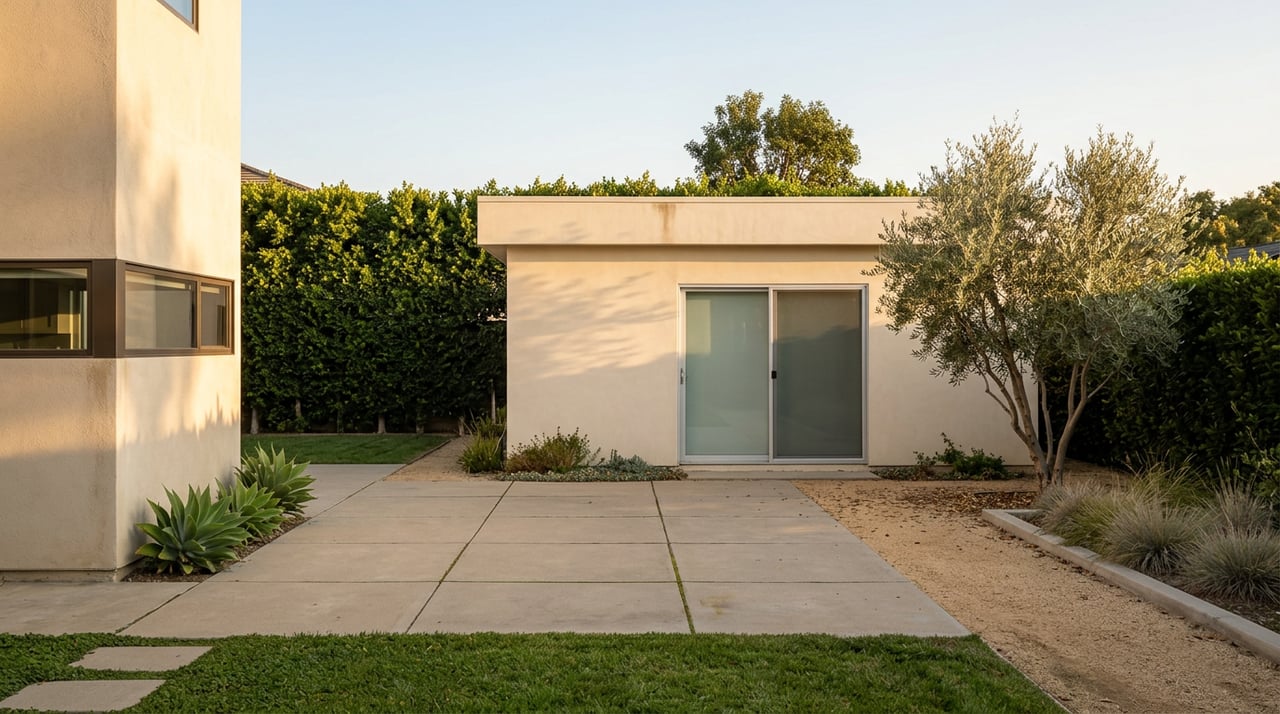
It's also incomplete. Eighteen paragraphs later, subsection (Q) of the same ordinance ministerially approves a larger combination: a conversion unit carved from existing house or accessory space, a junior ADU of up to 500 square feet inside the home, and a new detached ADU of up to 800 square feet with four-foot side and rear setbacks. Stacked together, that's two ADUs plus a junior ADU on one lot, no hearing required, decided by staff against objective standards rather than a public vote. The table at the top of the code and the mechanism at (Q) describe two different buildable envelopes, and the second one is the one that actually governs your permit.
What the table misses, and what (Q) actually approves
San Gabriel's ordinance folds state law into its own numbering, and the state framework it's built on, Government Code Section 66323, is what does the real work. Under that section, a single-family lot can combine a conversion ADU or a junior ADU with a separate new detached unit up to 800 square feet. Section 153.047 carries that stack into local code at subsection (Q), and the city's own ADU ordinance page confirms the local rules apply across every residential zone since the council's April 2024 update. You can read the full text of the section yourself at the American Legal Publishing library, and it's worth doing before you talk to a contractor, because the summary table is the version most people quote and it isn't the version that gets your permit approved.
The two numbers that decide whether your project fits
Two thresholds do the practical work on a San Gabriel lot, and they matter more than the total unit count.
The first is 800 square feet. A detached ADU at or below that size is shielded from the city's lot coverage and floor area arguments outright, the ordinance says so directly. Push past 800 and the extra footage gets pulled into the lot coverage and floor area ratio calculation, which is what actually decides whether a 1,000 square foot unit fits on a smaller Mission-area or Craftsman-era parcel where the main house already claims most of the buildable envelope.
The second is 750 square feet, the state impact fee line. Build at or under it and San Gabriel cannot charge impact fees at all. Go above it and fees apply proportionally, scaled either to the primary home's square footage or to its number of drainage fixtures, not charged as a flat rate.
| Threshold | What it protects |
|---|---|
| 800 sq ft | Below this, a detached ADU is exempt from lot coverage and floor area disputes |
| 750 sq ft | Below this, no development impact fees apply at all |
Neither number appears in the summary table. Both of them decide what actually gets built.
The historic district catch, and the track that sidesteps it
San Gabriel's conversion track, the (Q)(1) path for a unit carved from existing space, carries its own design conditions: landscape screening judged sufficient by the City Landscape Architect, conformity with the city's single-family design guidelines, and a requirement that the unit read as consistent with the main house. On a lot near the Mission district or one of the city's older Craftsman blocks, that screening standard is where a homeowner's plans can slow down.
The new detached 800 square foot unit approved under (Q)(2) and Government Code Section 66323 doesn't carry that same weight. State law prohibits a local agency from layering extra design standards onto a state-mandated unit beyond what Section 66323 itself specifies, which means the match-the-house requirement, the landscape screening test, and the discretionary design review that apply to a conversion ADU don't reach the new detached unit. Two homeowners on the same block, choosing two different tracks through the same ordinance, can end up facing two different levels of design scrutiny for a unit of roughly the same size.
The clock, and a paperwork gap the city hasn't closed yet
State law gives San Gabriel 60 days to approve or deny a complete ADU application. Miss that window and the project is deemed approved by operation of law, which is the leverage every applicant is quietly building a file toward.
A newer layer sits on top of that clock. Senate Bill 543 took effect January 1, 2026, and requires a city to determine whether an application is complete and notify the applicant in writing within 15 business days, a much tighter check-in than the old approach of silence until the 60-day mark. San Gabriel's local ordinance, adopted in April 2024 as Ordinance 706, predates that requirement and doesn't restate it anywhere in the local text. That doesn't mean the protection disappears. State law sets a floor a city can't drop below regardless of whether its own code has caught up to the citation, so the 15-day notice still applies here even though you won't find it written into San Gabriel's own section. A law firm summary of the four ADU bills signed in 2025 lays out how SB 543 and its companion bills changed the calendar for applicants statewide, and it's a useful gut check if your contractor or the counter staff quote you only the older 60-day language.
The fork: stack the ADUs, or split the lot
San Gabriel runs a second, separate ordinance for urban lot splits and urban dwelling units under Senate Bill 9, codified at Section 153.048. It caps a parcel at two units total once you count any existing ADU or junior ADU, and it works as an either-or with the ADU stack. If a lot already carries an ADU or junior ADU, an urban dwelling unit isn't permitted on it. Build an urban dwelling unit instead, and the ordinance closes the door on adding an ADU or junior ADU afterward. Whichever direction a homeowner picks first is largely the direction the lot is locked into.
The city's own fee schedule hints at how differently it treats the two paths. San Gabriel's FY26 Planning and Building Department fee schedule lists a $1,982 charge for a permit under the AB 1332 pre-approved ADU plan program, against a $9,790 fee for an SB 9 housing development application, roughly five times the cost before a shovel touches the ground. Modifying an approved ADU permit runs $552; modifying an approved SB 9 permit runs $7,505. That gap isn't an accident of administration. It's a rough measure of how much review each track is expected to require, and it's a real number for an investor weighing two rental units against a second, separately titled lot to hold or sell.
For a seller thinking about adding value before a listing goes live, or an investor comparing San Gabriel against other San Gabriel Valley cities, that fork is the decision that has to come before the design conversation, not after it. Rules like these are also why it's worth checking the specific city, not just the state framework: Altadena runs under a different set of ADU rules entirely because it's unincorporated county land rather than an incorporated city with its own municipal code, and a homeowner assuming one city's numbers apply across a property line can plan around the wrong ordinance.
Can I do both an ADU stack and an SB 9 lot split on the same San Gabriel lot? No. Section 153.048 treats them as mutually exclusive. An existing ADU or junior ADU forecloses an urban dwelling unit application, and an approved urban dwelling unit forecloses adding an ADU or junior ADU afterward.
Does a historic district location trigger extra design review for every ADU? Only for units built under the conversion track at (Q)(1). A new detached unit approved under the state-mandated stack at (Q)(2) isn't subject to the same landscape screening and match-the-house standards, because state law caps what design conditions a city can add to that track.
How fast does a complete application actually move in San Gabriel? The state floor is 60 days for a decision, with a 15-business-day completeness check required as of January 1, 2026 under Senate Bill 543, even though that timeline isn't yet spelled out in San Gabriel's own ordinance text.
Reading a zoning table and reading the ordinance underneath it are two different exercises, and the gap between them is usually where a project's real math lives. If you're weighing an ADU against an SB 9 split on a San Gabriel property, or thinking through how either one changes what a home is worth before you list it, I'd rather walk through the specific parcel with you than let a summary table make the call. You can see more of what's happening across San Gabriel real estate on the site, or just reach out directly.
Alex Lozano works Pasadena, Altadena, South Pasadena, and the San Gabriel Valley with the kind of hands-on attention a project like this deserves. Let's Connect.